Twitter Delicious Facebook Digg Stumbleupon Favorites More

Showing posts with label Flora and Fauna. Show all posts

05 May 2013

Florida couple gets rare encounter with killer whales in La Paz, B.C.S.

Today it's a beautiful Sunday in Cabo!
I woke up this morning and opened the window to enjoy the morning breeze. I realized there's no wind blowing like yesterday, not sure if it will be windy later on the day.

I browsed for Baja California news in my cellphone, and I found a video totally worth sharing about a great killer whales show near La Paz, B.C.S.

Reblogged article:

Florida couple gets rare encounter with killer whales in La Paz, Baja California Sur.

The magnificence of nature was on full display for a Florida couple celebrating their 20th wedding anniversary in La Paz, Mexico.

Florida divers Rich and Laura Howard got the experience of a lifetime as a pod of 17-20 Orcas/Killer Whales flipped and played alongside the couple’s boat for nearly one hour off the coast of La Paz
The Howard’s learned locals had seen the whales occasionally over the past decade, but no one had ever witnessed this behavior by the pod before.
According to the Howard’s website, “Oceans of Images:”
Killer Whales (Orcas) in this area are VERY RARE. Our diver master stated in ten years he has seen them only 3 times and they have NEVER had a close encounter like this. Luck plays a huge part sometimes in witnessing the awesome nature of God’s creatures. We were very lucky.
Indeed they were, and we thank them for sharing this incredible video with us!
Watch the Howard’s amazing video here:


Ads: Need a Mariachi Band for your wedding or any other event in Cabo?
Contact us: http://bit.ly/gavilancillo or send an email to: caboamazing@gmail.com

02 April 2013

Experts warn Mexico of high sea turtle mortality rates in Baja California Sur


Mexico City, Mar 13 (EFE).- International experts have warned President Enrique Peña Nieto that Mexico is experiencing high mortality rates among sea turtles off the coast of the northwestern state of Baja California Sur, the Mexican Center for Environmental Law, or CEMDA, said.

The Marine Turtle Specialist Group, or MTSG, sent a letter to Peña Nieto advising him that Baja California Sur has some of the highest sea turtle death rates in the world, CEMDA said in a statement.
The high mortality rates have been confirmed by both scientists and Mexican government agencies, CEMDA said.

More than 2,000 sea turtles died in 2012, an increase of 600 percent from the already high levels registered in the area over the past few years, CEMDA said.

MTSG experts conducted a study in 2011 to try to determine the state of sea turtles around the world and identified North Pacific turtles as among the most threatened.

The situation has worsened due to high accidental kills associated with small-scale fishing in the Gulf of Ulloa, CEMDA said.

The MTSG belongs to the survival commission of the International Union for Conservation of Nature, or IUCN, which was formed by more than 7,500 scientists from around the world and seeks to protect current global biodiversity levels.


Don't forget that CABO AMAZING! Has the most fun activities and transportation services for you and your family in Cabo! Send an email to caboamazing@gmail.com to request a service.

24 April 2012

OUCH!: Desert Plants of Baja California Sur

by EXPEDITIONJCS on APRIL 20, 2012 · LEAVE A COMMENT

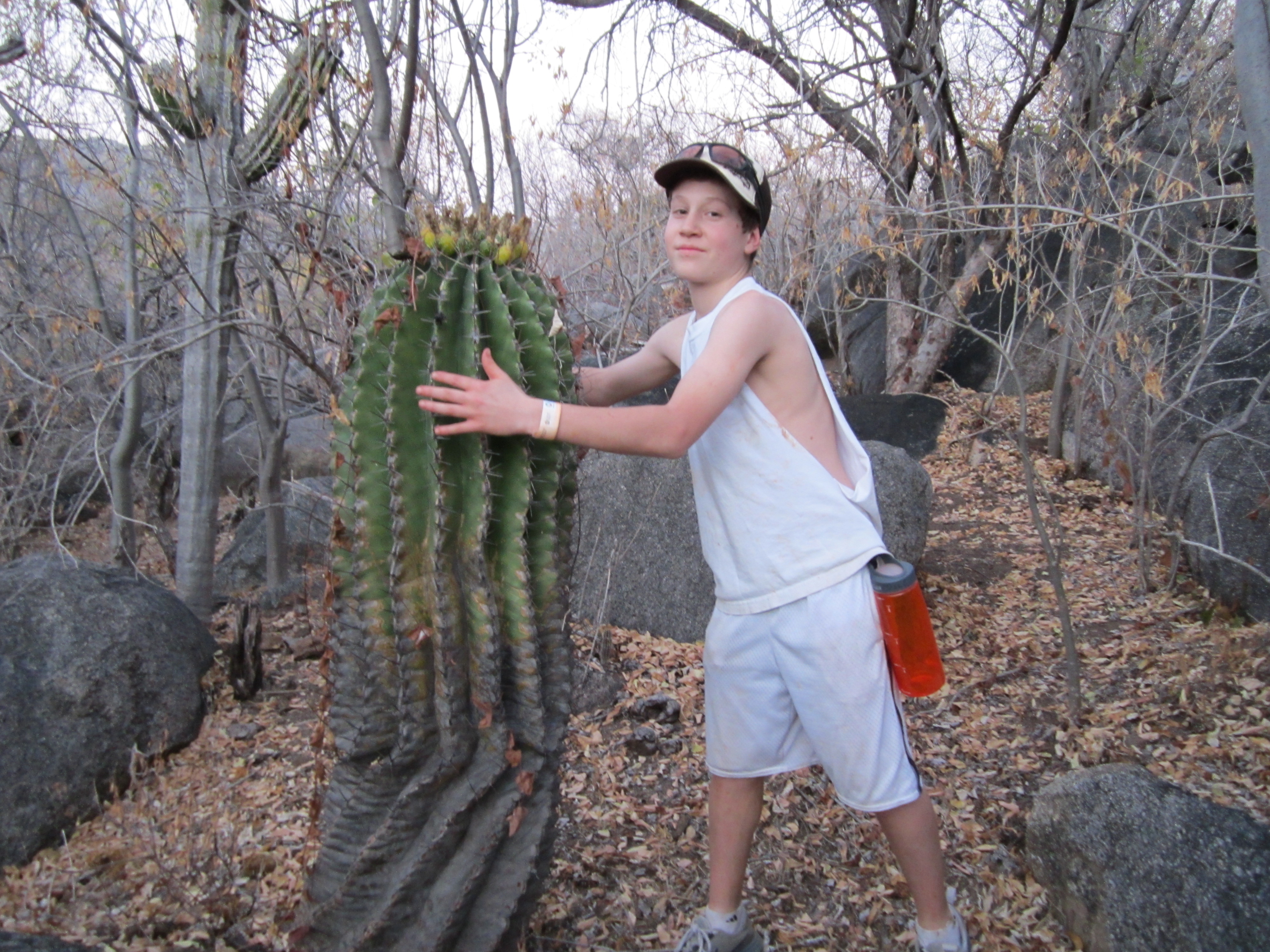
While a desert at first glance seems a harsh and desolate place I quickly realized that it was vibrant with life. When we were in wilderness areas it was just an expanse of bushes and cacti in all directions with trees only occurring near water sources. To my surprise, I found out that the dry sandy soil there has a very good nutrient mix for the growth of plants. However this amount of plant life proved to be a problem, as it seemed at least half of the desert plants had spines, spikes, blades, or other ways of inflicting pain and wounds on me and my classmates.

Dull green colors with sharp reactions
While the immediately obvious dangers were the cacti, many bushes also had such spikes. An early problem was a rather annoying class of plant that had blade-like leaves. These slashed light wounds across many of us, one cutting a nasty wound in Joe’s hand. This was mostly an early trip problem though. Another offender was a small green plant called “Good Woman”, which had sharp leaves that, while not doing significant damage to us most of the time, were painful and became a problem in the area near Edgardo’s (our guide) home. They were, thankfully, restricted mainly to areas near water. The plant was named “Good Woman” because it can be used to aid childbirth. The joke is “If this is the good woman, I’d hate to see the bad one.”
There were other plants as well, including many native cures. I experienced one such cure, a flower I was told would relieve sore throat and coughing. What I was not told was that the thing had an extremely powerful aftertaste. It was a sensation I cannot adequately describe. While I just fell into the experience of the blast, the one other person who also had one, immediately started chugging water in an attempt to wash it down. I might have been wiser to do so myself but somehow despite how uncomfortable it was I had a feeling that I should savor it. This was, from what I could tell, nothing compared to another incident.
While we were eating lunch at the home of a woman we had just helped construct a garden for, we noticed a number of small red peppers. Most of the students tried one and were inflicted with such suffering that they shoved ice cubes in their mouths in an attempt to make it go away. Witnessing this, I decided that I had no reason to inflict needless suffering on myself and chose not to try one.
Though the desert fauna was much less central to our desert experience than the flora, there were reminders that it was there. Most were minor, like a small animal off the side of the road or a lizard in our sink. Most notable weren’t the native fauna, but those introduced by humans. Cows so thin they were almost skeletal, obviously not equipped for the desert. Dogs that were a little thin, but still friendly as ever.
 One of the more striking experiences was, at one of our meals in a rural area, a pack of cats materializing out of the brush. Cats are naturally carnivorous, so it showed how desperate they were how they were willing to eat bread scraps. On the way out of the area we ran one over, but it popped back up again and ran like a polar bear was chasing it.

Joe and his new friend
A desert is a prime example of the adaptability of life. Plants and animals not only manage to survive there but thrive, and the difficulties of desert life have only made them tougher. It is difficult for our less hardened life to survive there, but it too can find a place. The trip would not have been the same without the animals we encountered, and the difficulties presented by the plants only made the destinations of our hikes better, as we had worked hard to reach them.
-Adam Braude, Age 14


Don't forget that CABO AMAZING! Has the most fun activities and transportation services for you and your family in Cabo! Send an email to caboamazing@gmail.com to request a service.

 
Design by Free WordPress Themes | Bloggerized by Lasantha - Premium Blogger Themes | Blogger Templates