Twitter Delicious Facebook Digg Stumbleupon Favorites More

Showing posts with label BCS. Show all posts

22 April 2015

We are sharing this Blogpost from our friends Cabo Ground Services. Source: http://cabogroundservices.blogspot.mx/2015/04/donate-toys-for-los-cabos-less.html#.VTf8I5NLDYg

Dear customers,
Hope you are doing great!

Hurricane Odile left many families hurting in their soul and minds but most importantly damaged their homes and took away their hope!  Nowadays Over 10 hotels remain closed  in the San Jose del Cabo area due to the re construction.
Due to this and because Children’s Day in Mexico is on April 30th, we wanted to ask you a personal favor, we are starting to collect toys for the Los Cabos less fortunate kids.

If you could bring some in your upcoming trip, it will be fantastic. It doesn't have to be new or big or expensive, just in good conditions and that it doesn’t use batteries even a hot wheels little car or a Barbie will make them happy!
If you have friends coming down please let them know as well, and give them the opportunity to help.

Another good option is to buy them when you go to Walmart or mega on the way to your hotel, just let the driver know about it and they will definitely stop for you!
You can also donate via our PayPal account ubielvilla@yahoo.com and we’ll buy them on your behalf!


These are kids and families t
hat will return a warm genuine smile. We will be taking pictures of their actual living conditions and also of the delivery of the toys and will be posting them in our Facebook page soon.

We totally understand if you can't but if you can spread the word, we'd really appreciate it!

If you need more information regarding the donation, please feel free to email us to info@cabogroundservices.com

Thank you for your time, we truly appreciate it!

Have a wonderful day!
Cabo Ground Services Team.

24 April 2012

OUCH!: Desert Plants of Baja California Sur

by EXPEDITIONJCS on APRIL 20, 2012 · LEAVE A COMMENT

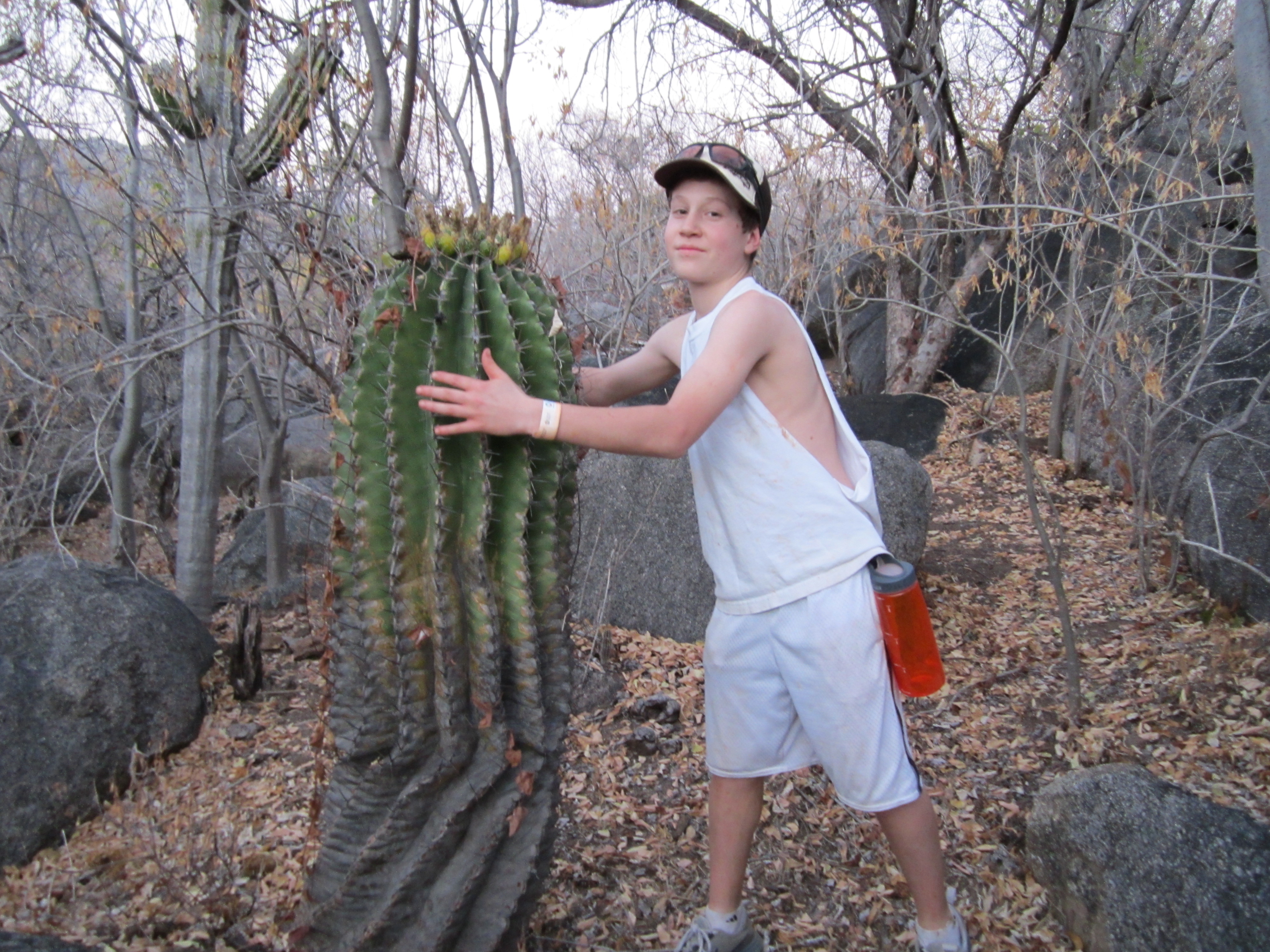
While a desert at first glance seems a harsh and desolate place I quickly realized that it was vibrant with life. When we were in wilderness areas it was just an expanse of bushes and cacti in all directions with trees only occurring near water sources. To my surprise, I found out that the dry sandy soil there has a very good nutrient mix for the growth of plants. However this amount of plant life proved to be a problem, as it seemed at least half of the desert plants had spines, spikes, blades, or other ways of inflicting pain and wounds on me and my classmates.

Dull green colors with sharp reactions
While the immediately obvious dangers were the cacti, many bushes also had such spikes. An early problem was a rather annoying class of plant that had blade-like leaves. These slashed light wounds across many of us, one cutting a nasty wound in Joe’s hand. This was mostly an early trip problem though. Another offender was a small green plant called “Good Woman”, which had sharp leaves that, while not doing significant damage to us most of the time, were painful and became a problem in the area near Edgardo’s (our guide) home. They were, thankfully, restricted mainly to areas near water. The plant was named “Good Woman” because it can be used to aid childbirth. The joke is “If this is the good woman, I’d hate to see the bad one.”
There were other plants as well, including many native cures. I experienced one such cure, a flower I was told would relieve sore throat and coughing. What I was not told was that the thing had an extremely powerful aftertaste. It was a sensation I cannot adequately describe. While I just fell into the experience of the blast, the one other person who also had one, immediately started chugging water in an attempt to wash it down. I might have been wiser to do so myself but somehow despite how uncomfortable it was I had a feeling that I should savor it. This was, from what I could tell, nothing compared to another incident.
While we were eating lunch at the home of a woman we had just helped construct a garden for, we noticed a number of small red peppers. Most of the students tried one and were inflicted with such suffering that they shoved ice cubes in their mouths in an attempt to make it go away. Witnessing this, I decided that I had no reason to inflict needless suffering on myself and chose not to try one.
Though the desert fauna was much less central to our desert experience than the flora, there were reminders that it was there. Most were minor, like a small animal off the side of the road or a lizard in our sink. Most notable weren’t the native fauna, but those introduced by humans. Cows so thin they were almost skeletal, obviously not equipped for the desert. Dogs that were a little thin, but still friendly as ever.
 One of the more striking experiences was, at one of our meals in a rural area, a pack of cats materializing out of the brush. Cats are naturally carnivorous, so it showed how desperate they were how they were willing to eat bread scraps. On the way out of the area we ran one over, but it popped back up again and ran like a polar bear was chasing it.

Joe and his new friend
A desert is a prime example of the adaptability of life. Plants and animals not only manage to survive there but thrive, and the difficulties of desert life have only made them tougher. It is difficult for our less hardened life to survive there, but it too can find a place. The trip would not have been the same without the animals we encountered, and the difficulties presented by the plants only made the destinations of our hikes better, as we had worked hard to reach them.
-Adam Braude, Age 14


Don't forget that CABO AMAZING! Has the most fun activities and transportation services for you and your family in Cabo! Send an email to caboamazing@gmail.com to request a service.

11 September 2011

Baja California Sur

The state of Baja California Sur, Mexico (along with its northern neighbor Baja California) forms part one of the world’s longest peninsulas, which extends 775 miles (1,247 km) south from the U.S. border into the deep blue of the Pacific. Literally “Lower California South,” Baja California Sur is as much U.S. as Mexico, which is probably why it’s so popular with U.S. visitors who enjoy the beauty, safety, and modern conveniences of the area.

Baja California Sur is sandwiched between the Pacific Ocean on the west and the Sea of Cortez (aka the Gulf of California) on the east. With all that coastline, it’s no wonder that Baja Sur has some of the best beaches and is one of the hottest spots for water sport activities and fishing excursions in all of Mexico.

The trans-peninsular highway is the state’s lifeline to the rest of Mexico and one of the great things about Baja in fact is the drive south through the desert highway offering one an opportunity do see and do it all.

Baja California Sur is most famous as home to the world-class tourist resorts of Los Cabos - Cabo San Lucas (the place to party) and San José del Cabo (the place to chill) are located at the state’s southern most tip and offer some spectacular scenery typified by the famous Arco and Cabo San Lucas’ marina where people come to dine, drink, party and set off for some world-class sailing and fishing… and a bit more dining, drinking and partying.

Baja California Sur’s famous twin towns are growing so fast that what was once the 30 kilometer desert no man’s land separating the two towns, Los Cabos Corridor, is developing into a tourist destination in its own right with restaurants, shopping, and tons of tons of chic real estate.

To say that the area is Americanized would be an understatement, with its sizeable gringo population and U.S.-style development; it’s practically part of the U.S. – sort of a clean, crime-free Florida in the desert. Yet, Baja California Sur’s developed tourist resorts are not the only things that make it one of Mexico’s most popular tourist destinations.

La Paz, the capital of Baja California Sur, is a lively cosmopolitan colonial city with many fun and interesting things to do, an off the beaten track delight that has one of Mexico’s oldest traditional seaside promenades. La Paz is also where you can get a ferry to Mazatlán that takes both you and you car to the mainland.

For ecotourists, the island of Espiritu Santo, an uninhabited natural reserve, is two hours from the La Paz.

The increasingly popular Todos Santos, famous for its artistic, bohemian culture, lays a hop, skip, and a jump to the north of Los Cabos. The town of Pescadero is located between La Paz and Cabo San Lucas - about 83 kilometers south of La Paz and about a 45-minute drive north from Cabo San Lucas. The area is mostly farmland and arroyos abutting the Pacific coastline, but developers with their eyes on tourism are hoping to change that.

From its coast, the Sierra Laguna Mountains give a magnificent display contrasting with the “huerta.” Set between the northern point of San Pedrito, a famous north swell surfing beach and to the south by the point of Los Cerritos that also has a famous surfing beach for the northern and south western swells, this area might have a future as a great launching point for surfers.

Buena Vista, Baja California Sur is a great spot to get away from it all, set around and as yet unspoiled coast, it’s a great place for fishing and kicking back – sort of what made Baja so popular in the first place.

Santa Rosalia, Mulege, and Loreto are all great cities to visit for their beautiful beaches and water sports, and a worthwhile side trip from Loreto is to the17th -18th century mission of San Javier in the Sierra la Giganta, the mountain range that parallels the gulf coast to the west. Along the way you can check out Cuevas Pintas and the cave paintings of abstract figures thought to be the visions experienced by a shaman.

The Vizcaino Biosphere Reserve in northern Baja California Sur is a natural spectacular wonder that anyone visiting the area will not want to miss!

Coming out of the Vizcaino Biosphere Reserve about 74 km south of San Ignacio, Highway 1, touches the Sea of Cortez for the first time in the ancient mining town of Santa Rosalía.

The town is like one you’d find in the Old West with its dusty streets and wooden houses with porches and balconies overlooking the town. It’s quaint and charming in an old-fashioned way, and while there are some good fishing spots here, it is a great stopping point for anyone traveling the highway between San Ignacio and Mulege. Of particular fame for this town is the El Boleo Bakery, which was built in 1901, and is still serving Mexican sweetbreads and rolls; visitors should be sure to stop there before moving on.

About 20 minutes from Mulege is Bahía Concepción a secluded area known for its stunning beaches crystal clear waters like Santiscpac, Posada Concepcion, and La Escondida. These beaches are known for their great accessibility to campers and RVers. Many retired Americans live here, taking in this paradise that is largely undeveloped virgin territory. Note that no plumbing is available on these beaches, and not much is offered in the way of tourist services, but that is largely part of the bay’s charm. Some locals rent kayaks and fishing boats, and stop by in the mornings selling water, ice, tortillas and fresh seafood.

And these are just a few of the attractions and things to see and do in Baja California Sur.

With its miles and miles of coastline, spectacular beaches, highly-developed tourist resorts with all the conveniences yet with just enough colonial tradition to give it some real old world charm, Baja California Sur is one of Mexico’s most popular tourist destinations – it’s a safe trip abroad, a first-rate adventure, yet all without really feeling like you’re too far away from home.

30 March 2011

::- VISIT MEXICO -:: Baja California Sur

"Live out a true romance in Los Cabos, a well-traversed destination for honeymooners, in the peninsula state of Baja California Sur. ... From: visitmexico.com/en/Visitmexico/Visi_baja_california_sur_r5?..."
BAJA CALIFORNIA SUR
Live out a true romance in Los Cabos, a well-traversed destination for honeymooners, in the peninsula state of Baja California Sur. If you travel the luxurious tourist strip of 33 km (21 mi) that runs from San José del Cabo to Cabo San Lucas, you will find one of the most important hotel developments in the country. Beyond that, there are exclusive restaurants, spas and top-of-the-line golf courses. You will find service lenders ready to help you try different kinds of aquatic sports including sport fishing, diving and kayaking. Discover romance at its fullest on Playa del Amor (Beach of Love), from where you can observe El Arco (The Arch), a monumental rock formation sculpted by the sea, where the waters of the Pacific Ocean meet those of the Sea of Cortés. 220 km (137 mi) north of Los Cabos along Highway 1 you will find La Paz.

In
this tourist destination there is a wide range of natural attractions such as the islands Isla Espíritu Santo and IslaCerralvo, both suitable for diving and discovering marine fauna like seals and sea lions. You can also visit the beach Pichilingue, seat of the international sport fishing championship called "Bisbee." La Paz will also tempt you with its nocturnal entertainment including bars, nightclubs and restaurants where you can try exquisite dishes such as grilled lobster in butter or fish tacos with delicious sweet and sour sauce. The next day, you can make your way to the utopian inlet of Bahía Loreto, located 350 km (218 mi) north of La Paz.

To
get there, take Highway 1 towards Ciudad Constitución, advance another 26 km(16 mi) to Ciudad Insurgentes and continue northeast 122 km (76 mi) until you reach this destination. It is surrounded by natural beauty like the Parque Marino Bahía de Loreto, consisting of a group of islands whose waters will allow you to dive and fish.

In contrast, the Sierra de La Giganta, covered with rock formations, provides an ideal environment
for hiking and mountain biking. Around here, you can admire rock paintings found in various caves of Sierra de San Francisco and the surrounding mountain ranges in the area known a Desierto Central de Baja California (Central Desert of Baja California).

You can also visit the Baroque-style missions of San Javier andNuestra Señora de Loreto – the two oldest in the region. Inside the bay, you will find beaches with calm surges such as Nopoló and Puerto Escondido, where you will enjoy a scrumptious variety of sea dishes like almejas chocolatas (clams) accompanied by mouthwatering varieties of white and red wines. At night, dance until sunrise in one of the nightclubs found in the city center.

From Loreto, make your way north along the same Highway 1 until you reach Santa Rosalía, then transfer to 223 km (139 mi) northwest to arrive at Guerrero Negro. In this destination you witness one of the most beautiful natural phenomenons that occurs on the Mexican coastline: the courting, mating and birth of grey whales.

This takes place in the lagoon Ojo de Liebre near Guerrero Negro, where the majority of these aquatic mammals concentrate. This spectacle can be seen close-up since there are services that will take you on a boat to within the permitted viewing area. Be sure to get some of the special earphones so that you can listen to the unique sounds of the whales. Enjoy a honeymoon surrounded by nature!

 
Design by Free WordPress Themes | Bloggerized by Lasantha - Premium Blogger Themes | Blogger Templates